Why Is Lauryl Azone in High Demand?
Lauryl Azone attracts attention because it can help certain ingredients pass through the outer skin barrier. In topical formulations, that possibility matters: a useful active ingredient has limited value if it cannot reach its intended site. Lauryl Azone is therefore discussed as a skin permeation enhancer in pharmaceutical and personal-care research. The appeal is practical. Formulators are looking for ways to improve delivery without simply increasing an active ingredient’s concentration.
Small formulation changes can matter. The choice of solvent, the product’s texture, and the properties of the active ingredient may all influence performance. Lauryl Azone’s effect is not identical in every formula, and better penetration does not automatically mean better results. Useful, but conditional. A laboratory finding may not translate directly into a finished product or real-world use. This is where enthusiasm needs a careful check.
Interest in Lauryl Azone reflects a broader demand for ingredients that give formulators more control over topical delivery. Researchers and manufacturers may evaluate it when developing creams, gels, or other skin-applied products. Yet its suitability depends on the formulation, the intended use, and appropriate safety and performance testing. The name alone proves little. Product claims should rest on reliable evidence, not on the assumption that one enhancer works equally well for every ingredient or skin type. Understanding both its potential and its limits helps explain why Lauryl Azone is in demand—and why that demand still calls for informed evaluation.
What Is Lauryl Azone and How Is It Defined?
Lauryl Azone, also called laurocapram, is a synthetic cyclic amide used as a topical penetration enhancer. Its structure combines a nitrogen-containing ring with a long, 12-carbon lauryl chain. PubChem records its molecular formula as C18H35NO and its molecular mass as 281.48 g/mol. In practical terms, formulators study it because it can interact with lipids in the stratum corneum, the skin’s outer barrier, and help some ingredients pass through. The effect depends on the active ingredient and the finished formula. Not a universal shortcut.
The name can be confusing: “Azone” is often used as a synonym for laurocapram, not as a description of every skin-enhancing ingredient. A market figure offers context, but not proof of demand for laurocapram specifically. Grand View Research estimated the global transdermal drug delivery systems market at USD 7.7 billion in 2023 and projected 9.2% annual growth from 2024 to 2030. That broader market includes many technologies and compounds. It should not be read as a laurocapram sales estimate. For technical evaluation, formulation-specific evidence matters more than market size; skin delivery can vary with concentration, vehicle, and the compound being delivered.
Lauryl Azone (laurocapram) is a cyclic amide used as a topical penetration enhancer. Its molecular formula, C18H35NO, contains a long carbon-rich chain alongside a cyclic amide structure. The chart shows the number of each type of atom in one molecule.
How Does Lauryl Azone Affect Skin Permeation?
Why Is Lauryl Azone in High Demand?
How Does Lauryl Azone Affect Skin Permeation?
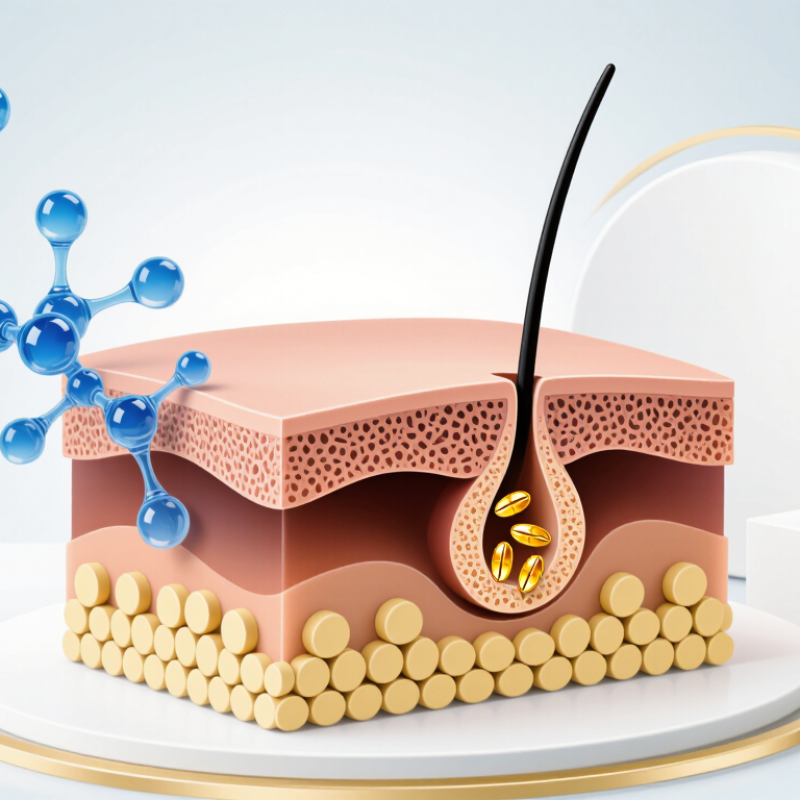
Lauryl Azone, also called laurocapram, can help active ingredients cross the stratum corneum, the skin’s outer barrier. It partitions into the barrier’s lipid layers and loosens their tightly packed structure. Think of the lipids as a brick wall: Azone makes the mortar less orderly, so some molecules can pass more readily. The effect depends on the active ingredient and formulation; it is not a universal shortcut.
A review by Williams and Barry in Advanced Drug Delivery Reviews (2004, 56:603–618) describes Azone as a chemical penetration enhancer and discusses changes to skin-lipid organization. Formulation studies commonly evaluate it at about 1–5% by weight. That range is a testing reference, not a promise of improved delivery or tolerability. Results can vary with the compound, dose, and skin condition. The evidence is useful, but the mechanism is not perfectly predictable.
Tips: Compare permeation data for the complete formulation, not Azone alone. Check the test method and exposure time. A small change in concentration may matter. Don’t assume more is better.
Why Is Lauryl Azone in High Demand? — How Does Lauryl Azone Affect Skin Permeation?
| Dimension |
Evidence-based summary |
Why it matters |
| What it is |
Lauryl Azone, also known as laurocapram, is a lipophilic cyclic amide used in some topical and transdermal formulations as a skin-penetration enhancer. |
Its formulation role is to help certain active ingredients cross the outer skin barrier; it is not itself a therapeutic active ingredient for every product. |
| How it affects the skin barrier |
Research describes its interaction with the stratum corneum, particularly the lipid-rich pathways between skin cells. It can alter lipid organization and increase barrier permeability under suitable formulation conditions. |
A more permeable barrier may allow a compatible drug to enter or pass through the skin more readily. |
| Effect on drug permeation |
The direction and size of any permeation change depend on the drug, its concentration, the vehicle, the amount applied, and the skin model or testing conditions. |
There is no single reliable fold-increase that applies to all drugs or products; performance needs to be measured for the specific formulation. |
| Why formulators may be interested |
It is studied as one option for improving delivery of selected compounds across the skin, which can be useful when passive skin transport is a formulation challenge. |
This potential utility helps explain continued technical interest, but does not establish a quantified market-demand level. |
| Factors affecting results |
Vehicle composition, enhancer concentration, drug solubility and partitioning, skin condition, application site, and exposure time can all influence results. |
A result from one formulation or laboratory model should not automatically be applied to another product or to all users. |
| Safety and tolerability |
Increasing skin permeability may also affect irritation potential or the amount of drug reaching the body. Tolerability depends on the finished formulation and exposure conditions. |
Formulations require appropriate safety, irritation, and drug-delivery evaluation; use in a product does not imply that every concentration or application is suitable for everyone. |
| Practical takeaway |
Lauryl Azone can enhance skin permeation for some drug–formulation combinations by influencing the outer skin barrier. |
Its effectiveness and safety are formulation-specific, so claims should be based on product-specific testing rather than a general assumption. |
Note: This table is a qualitative overview, not a product-specific efficacy or safety claim. Skin-permeation findings can vary with the formulation, test method, and study conditions.
Which Products and Industries Use Lauryl Azone?
Lauryl Azone, also called laurocapram, is valued mainly in topical drug-delivery research and formulation. It can help certain active ingredients pass through the outer skin layer. This makes it relevant to creams, gels, and some transdermal systems. The effect depends on the active ingredient, concentration, and finished formula; it is not a universal solution.
Pharmaceutical developers and formulation laboratories may evaluate Lauryl Azone when designing products for local skin delivery or studying absorption. Its use is more specialized than its presence in everyday cosmetics might suggest. Cosmetic and personal-care formulators may also assess it for selected topical products, but suitability depends on the product’s purpose, ingredient compatibility, and safety review. A clear, stable gel on a lab bench is only one part of the picture. Skin response and performance can vary, and those details deserve careful testing.
Tips: Check the ingredient’s role in the full formula, not just its name on a list. Review stability, skin-compatibility data, and intended-use requirements before selecting it. Small formulation changes can matter.
What Factors Are Driving Demand for Lauryl Azone?
Interest in Lauryl Azone is driven by the challenge of delivering active ingredients through the skin. The outer skin layer acts as a protective barrier, and some compounds pass through it poorly. Lauryl Azone is studied as a penetration enhancer because it can affect how ingredients interact with that barrier. This makes it relevant to topical and transdermal formulation research. The need is practical.
Formulators may consider it when comparing delivery options for creams, gels, or patches. A small change in ingredient level can alter how a formula spreads, feels, or releases its active compound. Performance also depends on the active ingredient, the surrounding vehicle, and the skin model used in testing. There is no universal result. Researchers therefore assess permeation alongside irritation, stability, and ingredient compatibility, rather than relying on a single laboratory reading. Those checks take time, and the evidence may not transfer neatly between formulations. That uncertainty is easy to underestimate. Demand is therefore tied not only to potential performance, but also to ongoing efforts to develop predictable, well-tested skin delivery systems.
What Challenges Influence Its Supply and Use?
Lauryl Azone attracts interest because it can help certain ingredients move through the outer skin barrier.
Yet its performance depends on the whole formulation, not one ingredient alone. A small change in concentration, solvent, or processing temperature may alter how a product spreads and behaves. Simple on paper. Less simple in a real batch.
Supply can be uneven because manufacturers must maintain consistent purity and composition. Buyers often need clear specifications for impurities, residual solvents, and batch-to-batch variation. Testing takes time, and changing a qualified source may require repeating important checks. Production capacity and access to suitable raw materials can also shift. These details rarely appear on a product label, but they affect planning.
Use presents its own challenges. Lauryl Azone may not suit every active ingredient or base, so formulators need compatibility and stability testing. They also assess skin tolerance, texture, and performance at the intended concentration. Lab results are useful, but they do not always predict a product’s behavior over months of storage. That uncertainty deserves attention. Evidence for one formulation should not be treated as proof for another, and careful evaluation remains essential.