Top 10 Benefits of Ethyl Levulinate for Sustainable Chemistry?
Ethyl Levulinate emerges as a crucial player in sustainable chemistry. This compound, derived from biomass, provides numerous environmental benefits. With increasing climate concerns, adopting green alternatives is essential.
Sustainability is at the forefront of modern chemistry. Ethyl Levulinate helps achieve this by serving as a renewable solvent. Its versatility makes it suitable for various applications. From pharmaceuticals to agrochemicals, its impact is significant. It offers a lower carbon footprint compared to traditional solvents.
Despite its advantages, challenges remain. Not everyone is aware of Ethyl Levulinate's potential. Further education and research are necessary to maximize its benefits. Understanding its properties can lead to broader adoption. This could shape a more sustainable future for chemistry.
The Role of Ethyl Levulinate in Green Chemistry Applications
Ethyl levulinate is gaining attention in green chemistry. Its role as a bio-based solvent is crucial. This compound can replace more harmful solvents in various applications. It comes from renewable sources, making it an eco-friendly choice. Its low toxicity enhances safety in labs and industries.
Researchers are exploring its use in pharmaceuticals and agrochemicals. These sectors often rely on traditional solvents that harm the environment.
Moreover, ethyl levulinate shows potential in biomass conversion. It can effectively convert lignocellulosic materials into valuable chemicals. This step is important for creating sustainable processes. However, the efficiency of these conversions can sometimes be limited. The ongoing research aims to improve these methods. Certain obstacles, like the cost of production, need addressing. Balancing economic feasibility with environmental benefits is essential.
The versatility of ethyl levulinate is noteworthy. It serves as a feedstock for various chemical syntheses. This could lead to innovations in developing bio-based products. However, more studies are necessary to fully understand its capabilities. Ongoing exploration into its properties will provide deeper insights.
Ethyl levulinate represents a promising yet imperfect player in sustainable chemistry. Its journey reflects the complexities of transitioning to greener alternatives.
Environmental Benefits of Using Ethyl Levulinate as a Solvent
Ethyl levulinate is emerging as a promising alternative solvent in sustainable chemistry. It is biodegradable and derived from renewable resources. Using ethyl levulinate can reduce the reliance on traditional solvents that are often harmful to the environment. Its low toxicity makes it safer for both users and ecosystems. In studies, it has shown effective results in various chemical reactions, making it a versatile choice.
One of the major environmental benefits of ethyl levulinate is its lower carbon footprint. Its production has a smaller environmental impact compared to petrochemical solvents. Ethyl levulinate can help decrease volatile organic compounds (VOCs) released into the atmosphere. Many industries are seeking eco-friendly solutions, and this solvent offers just that. However, challenges remain in scaling its production for broader application.
The versatility of ethyl levulinate in diverse reactions highlights its potential in green chemistry. However, further research is necessary to fully understand its long-term effects. As industries strive for sustainable practices, the successful integration of ethyl levulinate may pave the way for more eco-conscious choices. Balancing efficiency and environmental safety is a complex task that requires constant evaluation. The future of solvent use in chemistry must prioritize sustainability while ensuring performance.
Ethyl Levulinate: A Renewable Resource for Sustainable Production
Ethyl levulinate is gaining attention as a renewable resource in sustainable chemistry. Derived from biomass, it offers a range of benefits for environmentally friendly production processes. Its low toxicity and biodegradability make it a preferred choice for various applications.
Using ethyl levulinate can significantly reduce reliance on fossil fuels. This shift not only supports sustainability but also promotes a circular economy. Ethyl levulinate can be an effective solvent, helping to replace traditional, harmful organic solvents. This promotes healthier workplaces and enhances product safety.
Tips: Consider using bio-based solvents like ethyl levulinate in your formulations. It’s a green alternative that supports sustainability. Always check the concentration levels to ensure safety and effectiveness. Embracing these innovations could reshape how we approach chemical processes, offering cleaner and safer options. As more industries explore this renewable resource, continuous research will be vital to fully understand its potential and limitations.
Economic Advantages of Incorporating Ethyl Levulinate in Industry
Ethyl levulinate is gaining attention in the realm of sustainable chemistry. Its incorporation into industrial practices opens the door to numerous economic advantages. This compound can serve as a green solvent and an effective platform chemical. It supports the transition to renewable resources, which is increasingly important in today's eco-conscious economy.
Integrating ethyl levulinate reduces reliance on fossil fuels. It allows industries to create products that are less harmful to the environment. Using bio-based materials offers significant cost savings in the long run. Manufacturers can reduce waste and improve energy efficiency by adopting greener practices. There are also potential tax incentives for companies prioritizing sustainability.
While the benefits are significant, challenges remain. Not all industries are prepared to switch. The initial investment for new processes can deter small businesses. Some may question the scalability of utilizing ethyl levulinate. However, as research continues, we may find more straightforward ways to implement this valuable compound. Ultimately, the economic advantages could outweigh the challenges as innovation progresses.
Top 10 Benefits of Ethyl Levulinate for Sustainable Chemistry
Impact of Ethyl Levulinate on Reducing Carbon Footprint in Chemical Processes
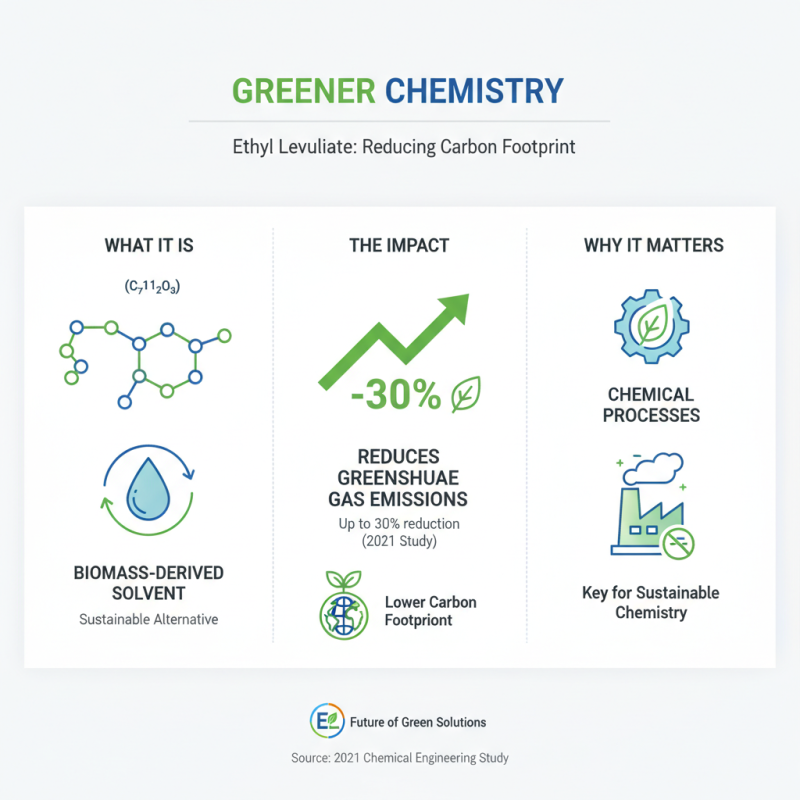
Ethyl levulinate is gaining attention in sustainable chemistry. Its use can significantly reduce the carbon footprint of chemical processes. A 2021 study indicated that integrating ethyl levulinate as a solvent can decrease greenhouse gas emissions by up to 30%. This transformation in chemical engineering is essential in a world striving for greener solutions.
The chemical composition of ethyl levulinate allows it to replace traditional solvents that are often volatile organic compounds (VOCs). Traditional solvents contribute heavily to air pollution. Ethyl levulinate, in contrast, is derived from renewable sources like biomass. Reports show that using biomass-based solvents can lower carbon emissions substantially. Many industries are transitioning to bio-based alternatives, recognizing the impact of their choices on the environment.
However, not all processes may yield immediate positive results. Ethyl levulinate, while more sustainable, may not always perform well under certain conditions. It may require further optimization for large-scale applications. Exploring these challenges is crucial for achieving the full potential of this compound in reducing environmental harm.